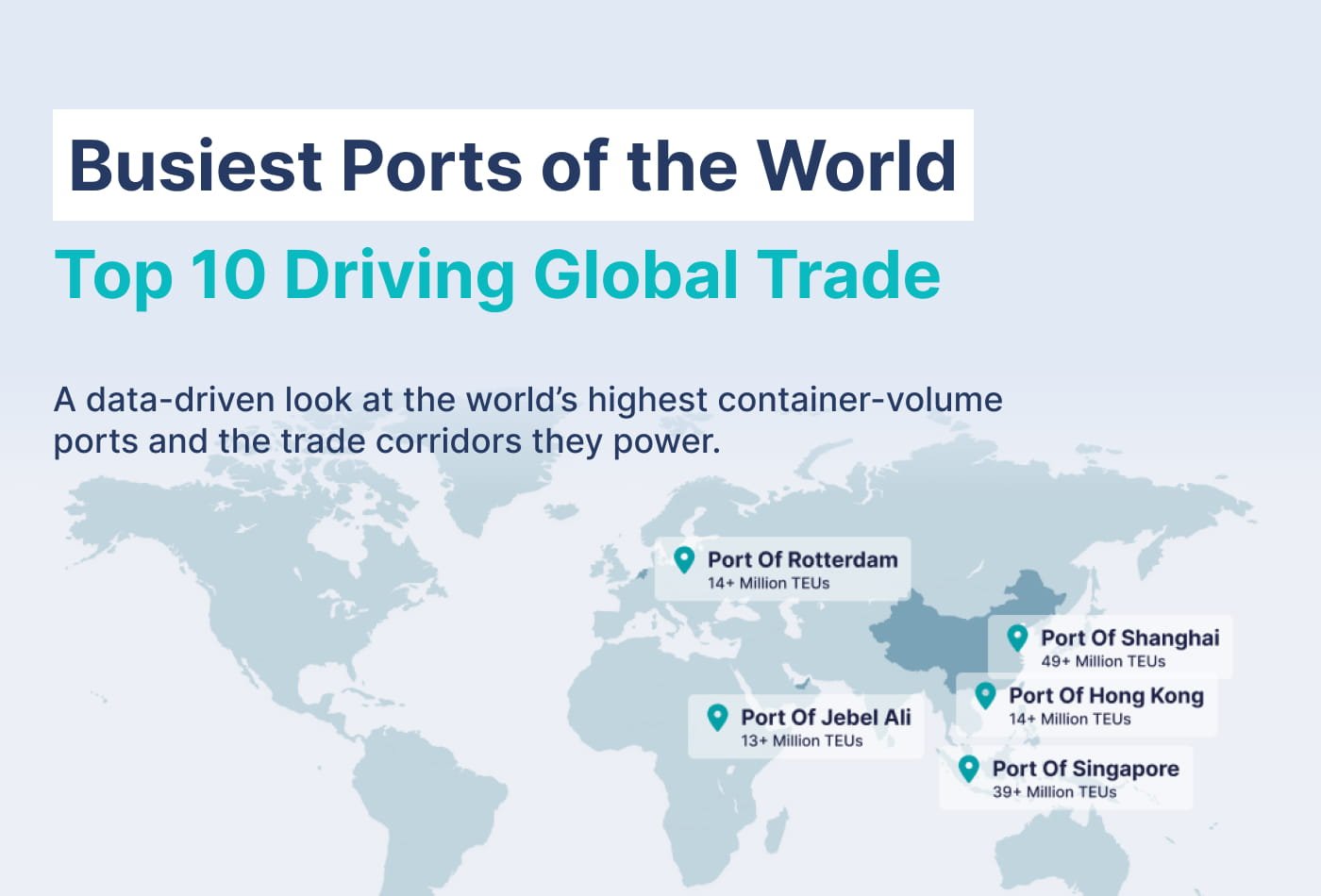
The busiest ports of the world are the backbone of international trade, handling millions of containers and billions of tonnes of cargo every year. These major world ports connect manufacturing hubs, consumer markets, and supply chains across continents.
Today, the busiest port in the world is Port of Shanghai, consistently ranking first in container throughput. It has held its position as the world's busiest port for several consecutive years, making it the benchmark for global port performance.
In this blog, we rank the top 10 busiest ports in the world based on container volume (TEUs), infrastructure scale, and global connectivity. If you're looking to understand which is the busiest seaport in the world and how major world ports compare, this guide breaks it down clearly.
How We Ranked the Busiest Ports in the World
The ranking is based on:
- Annual container throughput (TEUs)
- Strategic geographic location
- Shipping line connectivity
- Infrastructure & automation
- Role in global trade corridors
Container volume (measured in TEUs – Twenty-foot Equivalent Units) is the primary metric used globally to determine the busiest port of world trade.
Top 10 Busiest Ports of the World
1. Port of Shanghai – China
The Port of Shanghai is the busiest port in the world and a critical gateway for China’s export-driven economy. Located at the mouth of the Yangtze River, it connects inland manufacturing hubs with global shipping routes across Asia, Europe, and North America.
- Annual Throughput: 49+ million TEUs
- Location: Yangtze River Delta
- Key Trade Routes: Asia–Europe, Transpacific
It handles the highest container volume globally and plays a central role in China’s export economy. Its deep-water Yangshan Port and extensive river-port integration make it the leading busiest seaport in the world.
2. Port of Singapore – Singapore
The Port of Singapore is one of the busiest ports in the world and a leading transshipment hub. Its strategic location along major East–West trade lanes makes it a vital connector between Asia, Europe, and the Middle East.
- Annual Throughput: 39+ million TEUs
- Major Transshipment Hub
- Connects 600+ ports globally
The Port of Singapore is one of the most strategically located major world ports, serving as a key transshipment hub between Asia, Europe, and the Middle East.
3. Port of Ningbo-Zhoushan – China
The Port of Ningbo-Zhoushan is a major world port known for handling both containerized and bulk cargo in massive volumes. It plays a crucial role in supporting China’s heavy industries and global exports.
- Annual Throughput: 35+ million TEUs
- High cargo tonnage leader
- Strong bulk and container mix
4. Port of Shenzhen – China
The Port of Shenzhen serves the Pearl River Delta, one of the largest manufacturing regions in the world. It is among the busiest seaports in the world, especially for electronics and consumer goods exports.
- Annual Throughput: 30+ million TEUs
- Serves Pearl River Delta manufacturing hubs
- Major electronics export gateway
The Port of Shenzhen is crucial for China’s export-driven economy and remains one of the busiest seaports in the world.
5. Port of Guangzhou – China
The Port of Guangzhou is an integrated river and sea port that supports industrial and commercial activity across South China. It consistently ranks among the busiest ports in the world.
- Annual Throughput: 25+ million TEUs
- Integrated river-sea operations
- Key South China trade hub
Guangzhou continues to grow rapidly, reinforcing China’s dominance among the busiest ports in the world.
6. Port of Busan – South Korea
The Port of Busan is South Korea’s largest port and a strategic hub in Northeast Asia. It is widely recognized as one of the busiest seaports in the world for transshipment cargo.
- Annual Throughput: 22+ million TEUs
- Northeast Asia transshipment leader
- Advanced automation systems
Busan is a critical logistics hub connecting China, Japan, Russia, and the U.S.
7. Port of Qingdao – China
The Port of Qingdao is a major industrial gateway serving Northern China. Known for its advanced automation and cold chain facilities, it remains one of the busiest ports in the world.
- Annual Throughput: 23+ million TEUs
- Major industrial gateway
- Strong cold chain infrastructure
Qingdao is another Chinese giant among the busiest seaports in the world.
8. Port of Hong Kong – Hong Kong
The Port of Hong Kong has historically been one of the world’s busiest ports. Despite increasing competition from mainland China, it continues to serve as a vital international shipping and financial gateway.
- Annual Throughput: 14+ million TEUs
- Historically one of the world's busiest ports
- Strong global shipping connectivity
Although volumes have shifted to mainland China, Hong Kong remains a key international trade hub.
9. Port of Rotterdam – Netherlands
The Port of Rotterdam is Europe’s largest and busiest seaport. It serves as the primary gateway to the European Union, connecting inland markets through extensive rail, road, and river networks.
- Annual Throughput: 14+ million TEUs
- Largest port in Europe
- Gateway to the EU
Rotterdam is Europe’s leading container port and one of the most technologically advanced major world ports.
10. Port of Jebel Ali – UAE
The Port of Jebel Ali is the Middle East’s largest and most advanced port facility. It plays a strategic role in connecting Asia, Europe, and Africa through key maritime trade routes.
- Annual Throughput: 13+ million TEUs
- Middle East’s largest port
- Key Asia–Europe connector
Jebel Ali is the dominant logistics gateway in the Middle East and among the busiest ports in the world outside East Asia.
Economic Impact of the Busiest Ports of the World
The busiest ports of the world play a vital role in shaping the global economy. These major world ports handle enormous volumes of containerized and bulk cargo, facilitating international trade across continents. Their efficient functioning ensures smooth supply chain movement, supports industrial production, and maintains the balance between global imports and exports.
As global trade expands, the performance of the busiest seaports in the world directly impacts freight rates, delivery timelines, and economic growth worldwide.
Trade Facilitation
The busiest ports in the world act as primary gateways for international commerce. They connect manufacturing nations with consumer markets, enabling the export of finished goods such as electronics, machinery, automobiles, textiles, and chemicals, while supporting the import of raw materials, energy resources, and essential commodities.
These ports are strategically located along major shipping routes, making them critical nodes in Asia–Europe, Transpacific, and intra-Asia trade corridors. Any congestion at the busiest port in the world or other top global hubs can disrupt international trade flows and affect supply chains globally.
Industrial Support
Major world ports provide direct support to large industrial clusters. Their proximity to manufacturing zones, special economic zones (SEZs), and logistics parks ensures seamless cargo movement from factories to global markets.
Industries such as automotive, electronics, petrochemicals, steel, agriculture, and retail rely heavily on the infrastructure of the busiest seaports in the world. These ports enable high-volume cargo handling, efficient container turnaround, and multimodal connectivity through rail, road, and inland waterways.
Employment Generation
The operation and expansion of the busiest ports of the world create significant employment opportunities. Jobs are generated in port management, terminal operations, customs clearance, warehousing, trucking, freight forwarding, and maritime services.
Beyond direct employment, these ports stimulate regional economies by supporting logistics companies, shipping lines, financial services, and local businesses.
Revenue & Global Economic Growth
The busiest port of world trade activity contributes substantially to national GDP through port charges, customs duties, trade taxes, and logistics services. Collectively, the top 10 busiest ports in the world handle a major share of global container traffic, making them critical drivers of international commerce.
Their efficiency influences global freight rates, trade competitiveness, and overall economic stability.
Supply Chain Stability
The busiest seaport in the world and other leading global ports are essential for maintaining supply chain resilience. When disruptions occur—due to congestion, geopolitical tensions, or natural events—the ripple effects are felt across global markets.
Efficient port operations reduce delays, control costs, and improve shipment predictability, strengthening international trade networks.
Why Asia Dominates the Busiest Ports of the World
A majority of the top 10 busiest seaports in the world are located in Asia, particularly China. This dominance is driven by:
- Strong export manufacturing base
- Integrated port infrastructure
- High shipping frequency
- Strategic coastal positioning
China alone hosts several of the busiest ports in the world, reinforcing its position as a global trade leader.
Key Trends Among Major World Ports
1. Automation & Smart Port Technology
AI-based scheduling, automated cranes, and digital tracking systems are transforming port efficiency.
2. Mega Vessel Handling
Ports are expanding berth capacity to accommodate ultra-large container vessels (ULCVs).
3. Sustainability Initiatives
Green port strategies, shore power systems, and emission reduction programs are becoming standard.
4. Increased Transshipment Traffic
Strategic ports like Singapore and Busan thrive on cargo redistribution.
Why the Busiest Seaport in the World Matters
The performance of the busiest port in the world directly impacts:
- Global freight rates
- Shipping schedules
- Supply chain reliability
- International trade flows
When congestion occurs at the world's busiest port, ripple effects are felt worldwide.
Final Thoughts
The busiest ports of the world are more than just cargo hubs — they are economic engines shaping global commerce. From the Port of Shanghai, the current busiest seaport in the world, to strategic hubs like Singapore and Rotterdam, these ports define the speed and scale of international trade.
Understanding the busiest port of world trade activity helps businesses plan routes, optimize costs, and strengthen supply chain resilience.
As global trade continues to evolve, these major world ports will remain central to economic growth and logistics innovation.
Share Your Thoughts
Post


 Continue with Google



 Get instant quote
and compare offers in real time
Get instant quote
and compare offers in real time