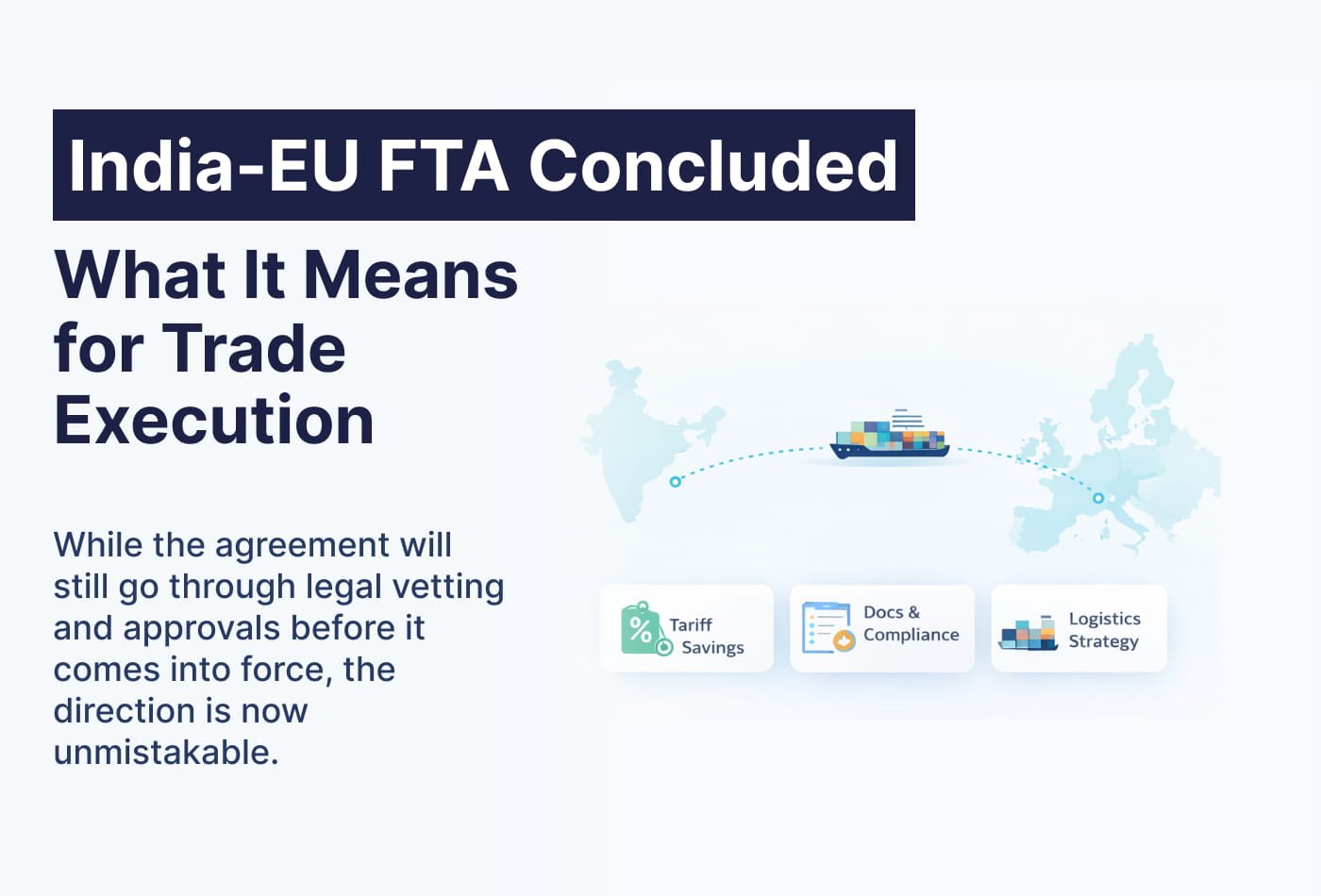
After nearly 18-20 years of negotiations, India and the European Union (EU) have officially concluded talks on their long-pending Free Trade Agreement (FTA), marking a historic moment in global trade relations. While the text of the deal will still undergo legal vetting and ratification before coming into force, the conclusion of the agreement lays the foundation for transformative changes in bilateral trade, logistics, and supply chains between two of the world’s largest economic blocs.
In this blog, we break down what the concluded FTA means for trade execution — from tariff changes and market access to logistics readiness and what businesses need to prepare for in the near future.
1. What Does “Concluded” Mean?
When officials say the India–EU FTA has been “concluded”, it means:
1. Negotiations have formally finished and both sides have agreed on the structure and content of the trade deal.
2. The agreement still needs to go through legal scrubbing, translation into official EU languages, and approvals from:
- The European Parliament
- The European Council
- India’s Union Cabinet
Only after those steps can a formal signing and ratification take place.
This process typically takes several months, and the deal is expected to be signed and implemented later in 2026 or early 2027.
2. Trade & Market Access Implications
Reduced Tariffs on Most Goods
Under the negotiated framework:
- Tariffs on over 90 % of goods traded between India and the EU are set to be reduced or eliminated, making exports and imports significantly cheaper and more competitive.
- For instance, duties on fully built European cars imported into India — which previously ranged up to 110 % — are expected to be phased down significantly over time.
Key Sector Benefits
Sectors likely to benefit include:
- Textiles, garments, leather and footwear, where lower duties can help Indian producers compete in the EU market.
- Pharmaceuticals and chemicals, where reduced non-tariff barriers and predictable access can boost exports.
- Machinery and electrical goods, which may become more cost-effective due to tariff cuts on parts and components.
The EU’s export potential to India — especially in automobiles, advanced machinery, and specialized inputs — will also improve, providing Indian businesses with cheaper and more diverse sourcing options.
Services and Other Trade Chapters
While goods trade is central to the FTA, services — particularly IT services, professional services, logistics, and telecommunications — are also expected to see liberalized market access rules, creating new opportunities for cross-border service delivery.
3. What It Means for Logistics and Trade Execution
For logistics and freight operations — especially on platforms like FreightMango — the concluded FTA brings several practical implications that businesses must address early:
3.1. Higher Export Volume — Planning & Capacity
With tariff barriers falling, exporters in labour-intensive sectors (like textiles or leather) and value-added segments (such as machinery and pharmaceuticals) are likely to target higher shipment volumes to the EU. This means:
- Greater demand for container capacity
- More predictable schedules
- Advance planning for peak seasons
FreightMango’s rate discovery and vessel schedule tools can help shippers plan strategically for these volumes.
3.2. Documentation & Trade Compliance
Post-FTA, regulatory and customs documentation gains greater importance:
- Rules of Origin (RoO) will determine tariff eligibility.
- Documentation compliance will directly impact duty savings.
- HS code accuracy and certificate verification become essential.
Digital platforms like FreightMango can help exporters ensure:
- Accurate paperwork
- Reduced delays at customs
- Faster booking and clearance
3.3. Port Pair Optimization
With trade flows expected to grow on major lanes like India → Rotterdam / Antwerp / Hamburg and EU → India ports, efficient port pair selection will matter more:
- Shorter transit times
- Cost-effective routing
- Regular sailing options
FreightMango’s port pair insights and carrier options help exporters choose the right combinations.
3.4. Cost Reductions and Competitive Advantage
The phased elimination of tariffs will gradually reduce landed costs. This has significant implications:
- Pricing power increases for Indian exporters.
- European buyers gain access to competitively priced Indian goods.
- Logistics players will need to factor in total landed cost reductions when advising shippers.
FreightMango’s rate comparison across carriers enables better cost management and competitiveness.
4. What Businesses Must Do Now
Even though the signed FTA text isn’t yet published, businesses should start preparing now:
4.1. Review Tariff Lines & Product Codes
Start identifying which products your business ships to the EU and:
- Map HS codes
- Estimate tariff savings once the FTA comes into effect
- Prepare supply chain adjustments
4.2. Audit Documentation
Ensure your:
- Certificates of origin
- Commercial invoices
- Packing lists are ready and aligned with RoO requirements.
4.3. Plan Logistics Early
With potential surge in shipment demand:
- Book vessels early
- Decide between FCL/LCL based on volume projections
- Leverage digital freight platforms for rate visibility
5. Limitations & What’s Not in the FTA Yet
While the deal is broad, some areas remain sensitive:
- Agriculture and dairy products may see limited tariff changes due to domestic sensitivities.
- Full tariff elimination will be phased in over several years, not instantly.
Conclusion
The conclusion of the India–EU Free Trade Agreement negotiations is a major milestone with deep implications for trade, logistics, and supply chains. Although the final legal text and signing are yet to follow, the direction is clear: greater market access, reduced tariffs, and expanded opportunities across key sectors.
For logistics platforms like FreightMango, this moment presents a chance to help businesses navigate an evolving trade environment — from tariff planning and documentation compliance to rate optimization and execution readiness.
Share Your Thoughts
Post


 Continue with Google



 Get instant quote
and compare offers in real time
Get instant quote
and compare offers in real time