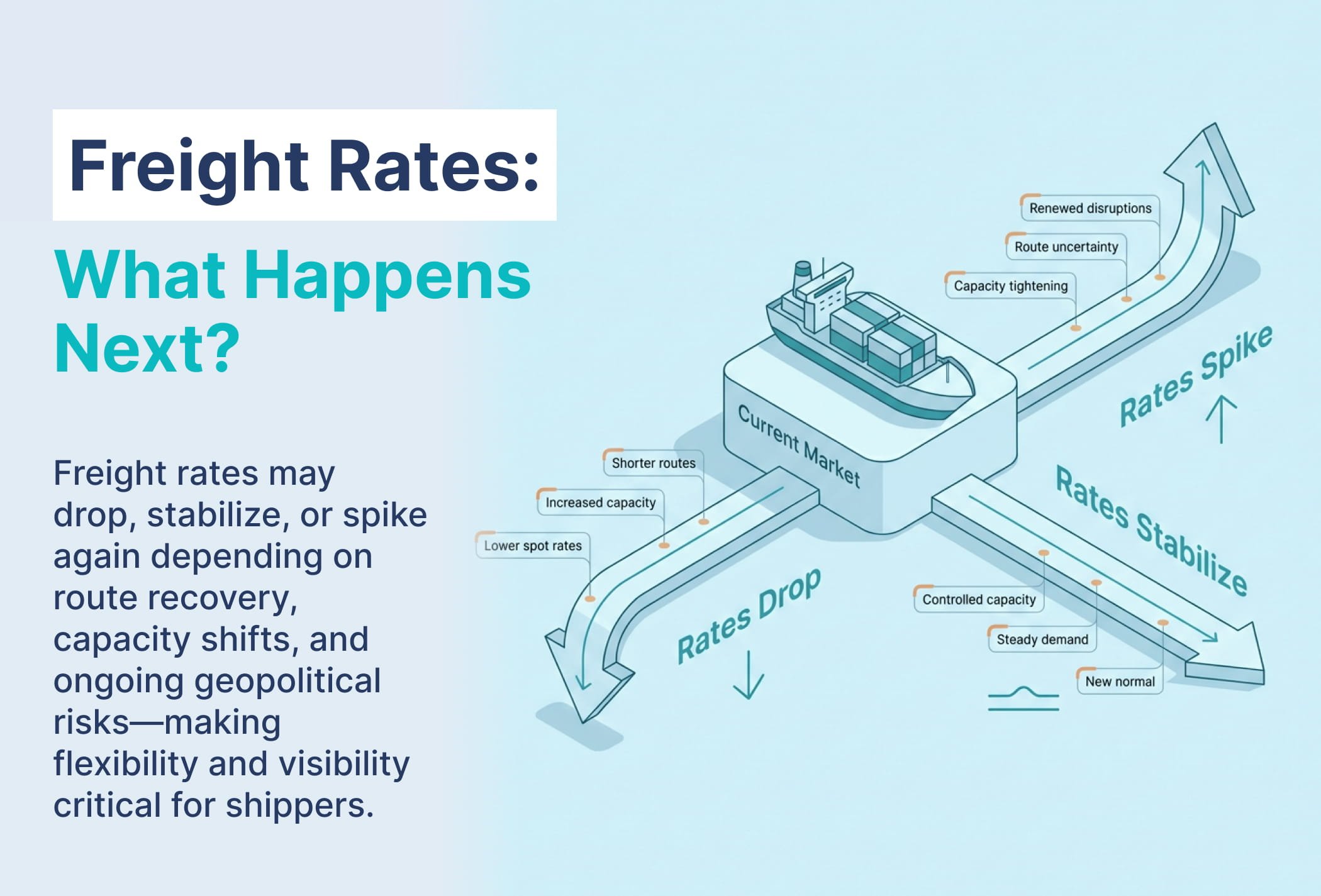
The past few months have been anything but stable for global logistics. Middle East disruptions have forced ships off their usual routes, increased transit times, and pushed freight rates to unpredictable levels.
Now, as the situation shows signs of easing, one big question remains for shippers:
Are freight rates about to fall—or is more volatility ahead?
Why Freight Rates Increased in the First Place
To understand what happens next, it’s important to look at what drove rates up:
- Route diversions: Most carriers avoided the Red Sea and Suez Canal, shifting to the Cape of Good Hope
- Longer transit times: Shipments took 10–20 extra days, increasing capacity pressure
- Higher fuel & operational costs: Longer routes = up to ~40% more fuel consumption
- Insurance premiums surged: War-risk zones increased costs significantly
As a result, global shipping capacity tightened, pushing freight rates higher and making planning difficult.
What’s Changing Now?
Recent developments indicate partial stabilization—but not a full reset:
- Some routes may gradually reopen, reducing the need for long diversions
- Global shipping capacity could increase if vessels return to shorter routes
- However, carriers remain cautious and are not rushing back immediately
At the same time, disruptions have already reshaped supply chains—and that impact doesn’t disappear overnight.
Scenario 1: Freight Rates May Drop (Short Term)
If more vessels return to standard routes:
- Shipping distances reduce → more effective capacity
- Vessel availability improves
- Spot rates may decline quickly
In fact, industry data suggests that a large-scale return to shorter routes could flood the market with capacity and sharply reduce rates
What this means for shippers:
Short-term opportunities to lock in lower spot rates.
Scenario 2: Rates May Stabilize (Most Likely)
Despite easing tensions, several factors will keep rates from falling too fast:
- Carriers will control capacity (blank sailings)
- Demand remains uneven across trade lanes
- Inventory restocking cycles may keep volumes steady
Also, disruptions have already increased global shipping distances and operational complexity, which continues to support higher baseline costs
What this means:
Rates may stabilize at a “new normal”—lower than peak, but higher than pre-disruption.
Scenario 3: Rates Could Spike Again (Risk Factor)
The biggest mistake shippers can make right now is assuming stability = certainty.
Why volatility may return:
- The region is still geopolitically fragile
- Carriers are hesitant to fully resume Red Sea routes
- Any renewed disruption can instantly tighten capacity again
In fact, many industry experts believe these disruptions could lead to long-term structural changes in shipping networks
What this means:
Freight rates are now event-driven, not just demand-driven.
So, What Should Shippers Do Now?
Instead of trying to predict rates perfectly, focus on flexibility and visibility:
1. Don’t wait for the “perfect rate”
Markets can shift faster than expected—secure rates when they align with your margins.
2. Balance spot vs contract
Spot: good for short-term opportunities
Contract: protects against sudden spikes
3. Track routes, not just prices
Route changes impact transit time, reliability, and total landed cost.
4. Prioritize visibility
During disruptions, lack of visibility caused more damage than high rates.
Final Takeaway
Freight rates are unlikely to follow a simple path.
Drop? Possible in the short term
Stabilize? Most likely scenario
Spike again? Very real risk
The real shift is this:
Logistics is no longer just about cost—it’s about how quickly you can respond to change.
Share Your Thoughts
Post


 Continue with Google



 Get instant quote
and compare offers in real time
Get instant quote
and compare offers in real time