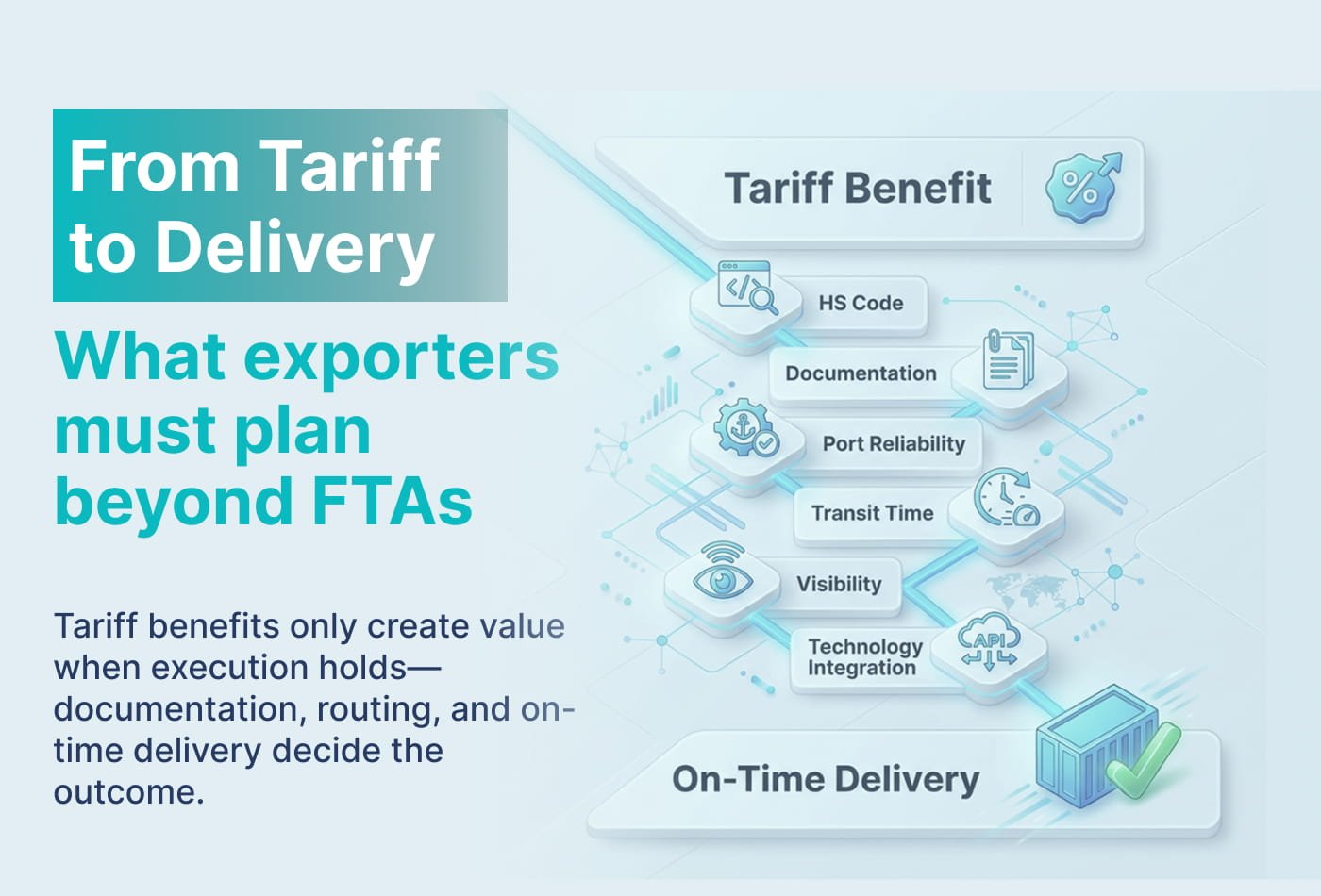
Free Trade Agreements (FTAs) are often viewed as a direct gateway to cost savings. Lower or zero duties promise better margins, stronger price competitiveness, and improved access to global markets. However, experienced exporters know a crucial truth: tariff benefits alone do not guarantee successful exports.
In real-world trade, savings on paper can quickly disappear due to delays, documentation errors, port congestion, or poor shipment planning. To truly convert tariff advantages into business outcomes, exporters must plan far beyond duty reduction and focus equally on operational readiness and delivery reliability.
1. Understanding Tariff Benefits Is Only the First Step
FTAs reduce or eliminate customs duties—but only when eligibility conditions are met precisely. This includes:
- Correct HS code classification
- Product-specific rules of origin
- Compliance with value addition norms
- Accurate certificates and declarations
Any mismatch can result in denial of benefits, retrospective duties, penalties, or shipment holds. More importantly, resolving such issues often consumes time—time that directly impacts delivery schedules.
Exporters must therefore treat tariff planning as a compliance-driven process, not a commercial shortcut.
2. Documentation Accuracy Directly Impacts Delivery Timelines
One of the most common reasons exporters lose both tariff benefits and delivery timelines is documentation inconsistency. Even when products are eligible under an FTA, errors such as:
- Incorrect origin details
- Mismatch between invoice, packing list, and Bill of Lading
- Missing or outdated certificates
can trigger customs queries at origin or destination.
These checks don’t just affect duties—they stall cargo movement. In high-volume ports or peak seasons, even a short documentation delay can push shipments to the next sailing or create storage and demurrage costs. On-time delivery begins with document accuracy, not vessel departure.
3. Port and Sailing Reliability Matter More Than Expected
Exporters often plan shipments based on tariff savings without factoring in port performance and sailing reliability. Congested ports, blank sailings, or transshipment delays can offset any duty advantage gained through FTAs.
For example:
- A shipment with zero duty but delayed delivery may lead to buyer penalties or order cancellations
- Missed delivery windows can impact long-term contracts and trust
- Inventory disruptions at the buyer’s end may outweigh tariff savings
Exporters must evaluate not just “where duties are lower” but how reliably goods can move through those routes.
4. Transit Time Planning Is a Commercial Decision
In global trade, time is money. Exporters supplying seasonal goods, industrial inputs, or just-in-time inventory cannot afford transit uncertainty.
Choosing a route solely because it qualifies for FTA benefits—while ignoring longer transit times or unstable schedules—can hurt customer commitments. Exporters should align:
- Transit time expectations
- Buffer planning for customs clearance
- Contingency options for disruptions
Tariff benefits only create value when delivery timelines align with buyer expectations.
5. Visibility Is No Longer Optional
Once cargo is on the water, lack of visibility can quickly turn small delays into major issues. Exporters need real-time access to:
- Vessel movement updates
- Port arrival and departure changes
- Transshipment risks
- Exception alerts
Without visibility, exporters often learn about delays only when buyers escalate—by then, it’s too late to act. Proactive shipment tracking allows exporters to communicate early, adjust plans, and protect relationships, even when disruptions occur.
6. Coordination Between Commercial and Logistics Teams Is Critical
A common internal gap exists where commercial teams focus on pricing and tariff benefits, while logistics teams handle execution independently. This disconnect leads to:
- Sales commitments made without transit feasibility checks
- Incorrect assumptions on delivery timelines
- Missed coordination on documentation readiness
Exporters that succeed under FTAs ensure cross-functional planning, where tariff strategy, shipping execution, and delivery commitments are aligned from day one.
7. Technology Enables Execution, Not Just Planning
Modern export operations require more than spreadsheets and email follow-ups. Exporters managing multiple markets, FTAs, and shipping partners benefit from platforms that:
- Centralize shipment data
- Track multiple carriers in one place
- Flag delays early
- Reduce manual follow-ups
Technology bridges the gap between planning and execution, ensuring tariff advantages translate into predictable deliveries.
8. The Real Metric: Delivered Value, Not Duty Saved
Ultimately, buyers don’t measure success by how much duty an exporter saved—they measure it by on-time, in-full delivery. A shipment that arrives late, incomplete, or under dispute erodes confidence, regardless of tariff benefits.
Successful exporters shift their mindset from:
“How much duty can we save?”
to
“How reliably can we deliver at the promised cost and time?”
Conclusion
FTAs are powerful tools, but they are not automatic profit drivers. The real challenge lies in execution—documentation accuracy, port performance, transit planning, visibility, and coordination.
Exporters who plan holistically—connecting tariff strategy with logistics readiness—are the ones who truly convert policy benefits into commercial success. In today’s volatile trade environment, on-time delivery is the ultimate return on tariff savings.
Share Your Thoughts
Post


 Continue with Google



 Get instant quote
and compare offers in real time
Get instant quote
and compare offers in real time