India’s trade ecosystem depends heavily on its ports. From consumer electronics and automobiles to agricultural products and industrial machinery, a large portion of the country’s imports and exports move through seaports every single day. As a nation with a coastline stretching over 7,500 kilometers, India has developed an extensive maritime network that connects domestic industries to global markets through some of the biggest ports in India.
Ports are more than just docking points for ships. They are highly organized logistics hubs where cargo is received, stored, inspected, processed, and transported further through road, rail, and inland transport systems. Understanding how ports work in India helps businesses, exporters, importers, and logistics professionals better understand the backbone of international trade.
What Is a Seaport and Why It Matters
A seaport is a coastal facility where ships load and unload cargo or passengers. These ports act as gateways for international commerce and are essential for the movement of goods between countries. Every imported product entering India by sea and every exported shipment leaving the country passes through a structured port operation process.
Ports play a crucial role because maritime transport remains one of the most cost-effective ways to move bulk cargo over long distances. Compared to air transport, shipping is significantly more economical for heavy or large-volume goods. This makes ports critical for industries such as manufacturing, agriculture, oil and gas, automotive, textiles, chemicals, and retail.
In India, ports are managed by a combination of government authorities and private operators. The country has major ports controlled by the central government and several non-major ports managed by state governments. Over the years, modernization initiatives have improved cargo handling capacity, digital tracking, customs processing, and multimodal connectivity.
Ports also support economic development by generating employment opportunities, encouraging industrial growth near coastal regions, and attracting foreign trade investments. Special Economic Zones (SEZs), logistics parks, and container freight stations are often built around major ports to streamline cargo movement.
Types of Ports in India
India’s port infrastructure is designed to handle different categories of cargo and transportation requirements. Ports can be classified in multiple ways based on ownership, cargo type, and operational specialization.
Major Ports
Major ports are governed by the central government and handle a significant portion of India’s maritime trade. These ports are strategically located across both eastern and western coastlines and are equipped with advanced infrastructure to manage high cargo volumes.
Some major ports focus heavily on container traffic, while others specialize in crude oil, coal, iron ore, fertilizers, or industrial raw materials.
Non-Major Ports
Non-major or minor ports are managed by state maritime boards or private operators. Many of these ports have grown rapidly due to increasing regional trade and private sector investments. They often support coastal shipping, regional exports, and industrial cargo movement.
Container Ports
Container ports primarily handle standardized shipping containers used in international trade. These ports use cranes, container yards, and digital tracking systems to efficiently manage imports and exports.
Containerization has transformed logistics because it enables faster cargo handling, better security, and seamless transportation across ships, trucks, and trains.
Bulk Cargo Ports
Bulk cargo ports manage unpackaged commodities such as coal, iron ore, grains, cement, and petroleum products. These ports require specialized loading and unloading systems due to the nature of the cargo.
Specialized Ports
Some ports are designed for specific industries or cargo categories. For example, LNG terminals handle liquefied natural gas, while certain ports focus on automobiles or petrochemical cargo.
India’s growing maritime infrastructure ensures that different industries have dedicated facilities that improve operational efficiency and reduce transit delays.
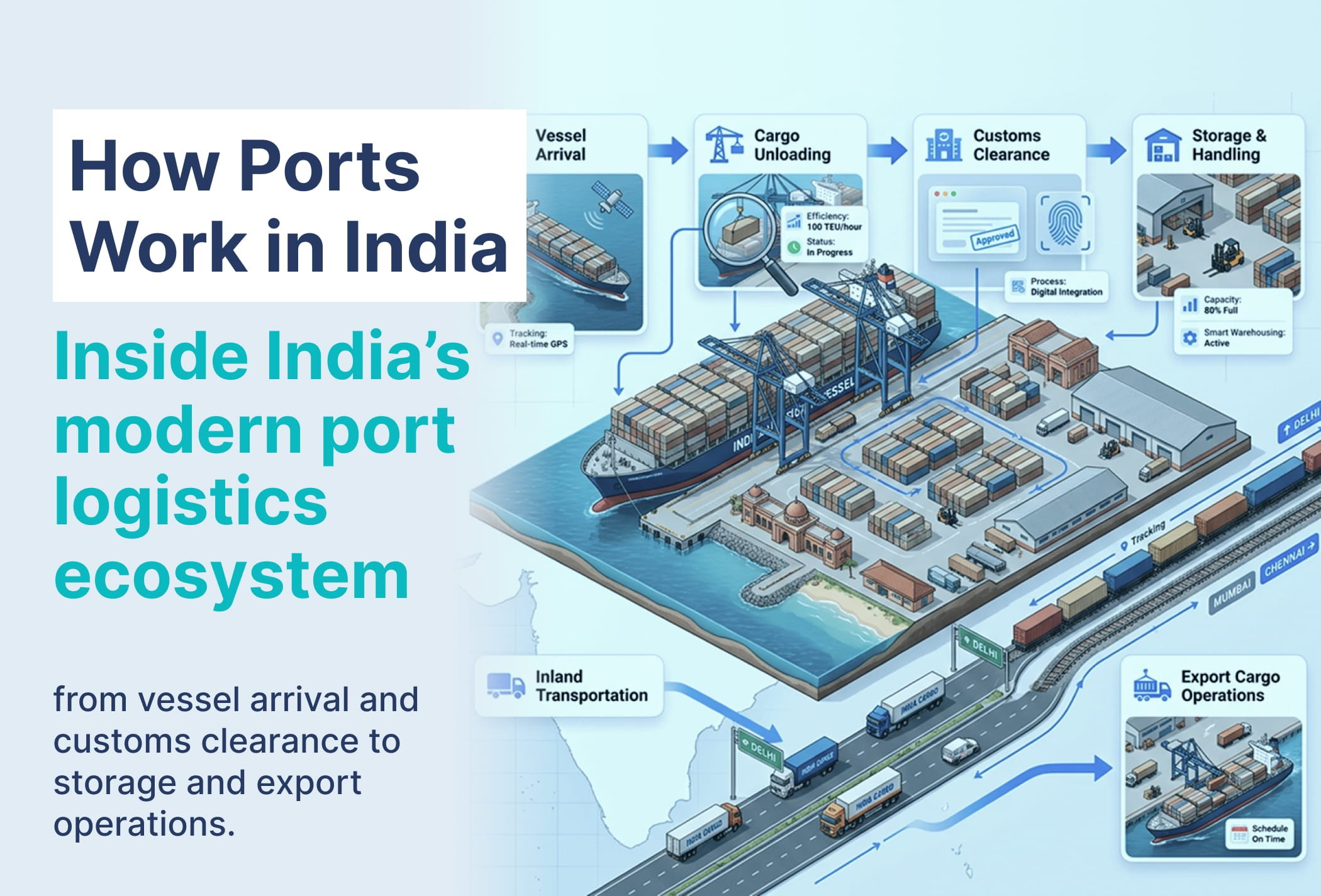
How Cargo Moves Through a Port
The movement of cargo through a port involves multiple coordinated steps involving shipping lines, customs authorities, freight forwarders, transporters, terminal operators, and logistics providers.
Arrival of the Vessel
The process begins when a cargo vessel approaches the port. Before arrival, shipping companies submit documentation related to cargo manifests, vessel schedules, and customs declarations.
Port authorities assign berthing space where the vessel docks for loading or unloading operations.
Unloading the Cargo
Once docked, cranes and cargo handling equipment unload containers or bulk cargo from the ship. Containers are transferred to container yards, while bulk cargo may move through conveyor systems, pipelines, or storage terminals.
The speed and efficiency of unloading operations depend on port infrastructure, labor coordination, and equipment availability.
Customs Clearance
Imported cargo must undergo customs verification and clearance procedures. Authorities inspect documentation, verify duties and taxes, and ensure compliance with import regulations.
Digital systems have significantly improved customs efficiency in Indian ports by reducing paperwork and enabling electronic document submission.
Storage and Handling
After clearance, cargo may be temporarily stored in warehouses, container freight stations, or bonded storage facilities. During this stage, shipments can be sorted, consolidated, or prepared for inland transportation.
Many ports now integrate technology-driven inventory management systems that provide real-time cargo visibility.
Inland Transportation
Once cleared, cargo moves to its final destination through trucks, railways, or inland waterways. Strong multimodal connectivity is essential because efficient transportation beyond the port directly impacts supply chain performance.
Ports connected to dedicated freight corridors and industrial zones usually experience smoother cargo movement and reduced congestion.
Export Cargo Operations
For exports, the process works in reverse. Goods arrive at the port from factories or warehouses, undergo documentation and customs checks, and are then loaded onto vessels bound for international destinations.
Modern logistics providers also offer end-to-end visibility that allows businesses to track shipments throughout the export journey.
Why Ports Are Critical for India’s Economy
Ports are one of the strongest drivers of economic growth in India. Since the country depends heavily on international trade for industrial development and consumer demand, efficient ports directly influence economic performance.
A major share of India’s trade by volume moves through maritime transport. Ports enable industries to import raw materials, machinery, and energy products while supporting exports across sectors such as pharmaceuticals, textiles, engineering goods, chemicals, and agriculture.
Efficient ports reduce logistics costs and improve supply chain reliability. When cargo moves faster through ports, businesses experience lower inventory costs, shorter lead times, and better competitiveness in international markets.
Ports also support India’s manufacturing ambitions by connecting factories to global buyers and suppliers. Programs focused on industrial growth and export expansion rely heavily on port modernization and infrastructure development.
The rise of e-commerce, global sourcing, and cross-border trade has further increased the importance of efficient port operations. Businesses today require predictable transit times, digital shipment visibility, and streamlined customs procedures to meet customer expectations.
Ports contribute to regional development by creating jobs in transportation, warehousing, shipping, customs brokerage, and logistics services. Coastal economic zones around ports often become major industrial and commercial hubs.
India has also invested heavily in maritime development projects aimed at improving port connectivity, cargo capacity, and operational efficiency. These initiatives are designed to strengthen India’s position in global trade networks and reduce overall logistics bottlenecks.
How This Connects to India’s Largest Ports
Understanding how ports work becomes even more relevant when looking at the scale and importance of India’s largest maritime hubs. Major ports across the country manage millions of tonnes of cargo annually and serve as critical gateways for international commerce.
These ports handle diverse cargo categories ranging from containers and automobiles to petroleum products and bulk commodities. Their infrastructure, connectivity, and operational capabilities play a direct role in determining trade efficiency across industries.
As India continues to strengthen its logistics and maritime infrastructure, ports will remain central to economic growth, export competitiveness, and supply chain efficiency. Businesses involved in international trade must understand port operations to make better shipping decisions, reduce delays, and optimize cargo movement across global markets.
Share Your Thoughts
Post


 Continue with Google



 Get instant quote
and compare offers in real time
Get instant quote
and compare offers in real time