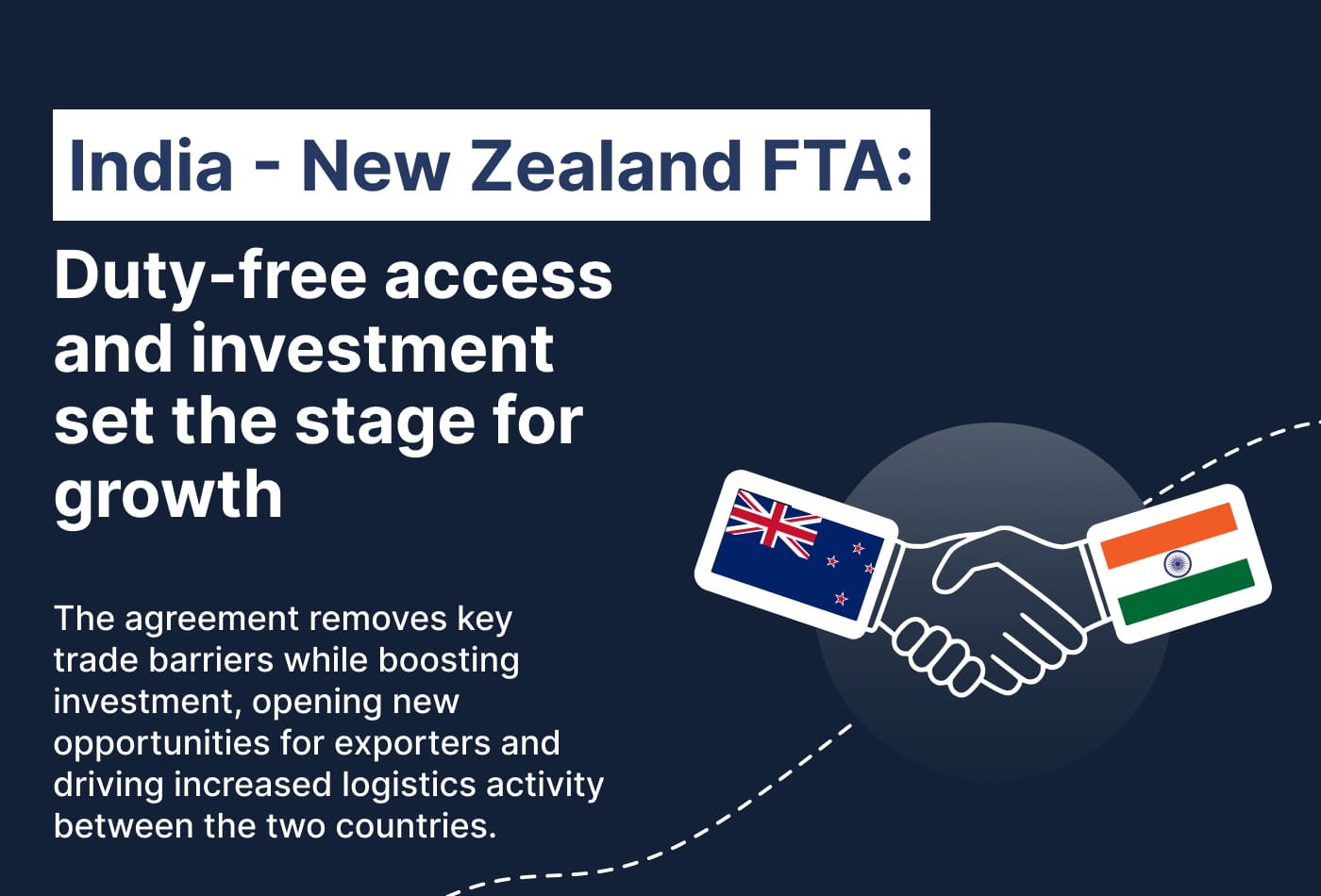
The newly signed Free Trade Agreement between India and New Zealand marks a significant milestone in global trade. Called a “once-in-a-generation” deal by New Zealand Prime Minister Christopher Luxon, the agreement reflects a deeper shift in how countries are building resilient and future-ready trade partnerships.
Signed at Bharat Mandapam in Delhi, the agreement is designed to strengthen economic ties while opening new opportunities for businesses on both sides.
A Deal Built for Scale and Access
At the heart of this agreement is a major trade enabler—New Zealand has granted 100% duty-free access to Indian exporters. This effectively removes one of the biggest barriers to entry, making Indian goods far more competitive in the New Zealand market.
Alongside this, the agreement includes an estimated $20 billion in investment commitments from New Zealand into India. This is expected to support infrastructure, trade ecosystems, and long-term economic collaboration between the two countries.
What makes this FTA particularly important is not just the scale of benefits, but the intent—it is structured to encourage sustained trade growth rather than short-term gains.
What It Means for Indian Exporters
For exporters, this agreement opens up a relatively untapped yet high-potential market. With duties eliminated, Indian products across sectors such as textiles, pharmaceuticals, agriculture, and engineering goods can enter New Zealand with a clear pricing advantage.
Beyond cost benefits, the agreement also simplifies trade processes, which can significantly reduce delays and administrative friction. This means faster movement of goods, improved turnaround times, and more predictable delivery cycles.
Over time, New Zealand can also act as a strategic gateway into the broader Oceania region, helping Indian businesses expand their footprint beyond a single market.
A Ripple Effect on Logistics and Supply Chains
Trade agreements of this scale don’t just impact exporters—they reshape entire supply chains. As trade volumes increase between India and New Zealand, logistics networks will need to adapt quickly.
Ocean freight is expected to see a steady rise, particularly for bulk shipments, while air freight demand may grow for high-value or time-sensitive cargo. This shift will require more efficient route planning, better coordination, and stronger multimodal connectivity.
At the same time, the importance of inland logistics and warehousing will grow. As cargo volumes increase, businesses will need reliable storage, faster distribution networks, and seamless first- and last-mile connectivity to keep operations efficient.
The Growing Role of Digital Logistics
As complexity increases, traditional logistics approaches may struggle to keep up. This is where digital platforms and AI-powered tools become essential.
End-to-end visibility, real-time tracking, and predictive analytics will no longer be optional—they will be critical for managing shipments efficiently across borders. Businesses will increasingly rely on integrated logistics solutions that combine freight booking, customs handling, and documentation into a single streamlined experience.
For platforms like FreightMango, this creates an opportunity to simplify cross-border trade while helping businesses optimize both cost and transit time.
A Broader Shift in Global Trade
The India–New Zealand FTA also reflects a larger global trend. Businesses are actively diversifying trade routes and partnerships to reduce risk and improve supply chain resilience. Instead of relying heavily on a few traditional corridors, companies are exploring new and emerging trade lanes.
This agreement strengthens India’s position as a key global trading hub while reinforcing New Zealand’s role as a strategic partner in the Asia-Pacific region.
Final Thoughts
The India–New Zealand Free Trade Agreement is more than just a policy update—it’s a catalyst for long-term trade growth. By combining duty-free access with strong investment commitments, it creates a foundation for deeper economic collaboration.
For exporters, it means new markets and better margins. For logistics providers, it signals increased demand and the need for smarter, more agile solutions.
As trade between India and New Zealand accelerates, the real advantage will lie with businesses that can move quickly, adapt efficiently, and leverage the right logistics ecosystem to stay ahead.
Share Your Thoughts
Post


 Continue with Google



 Get instant quote
and compare offers in real time
Get instant quote
and compare offers in real time