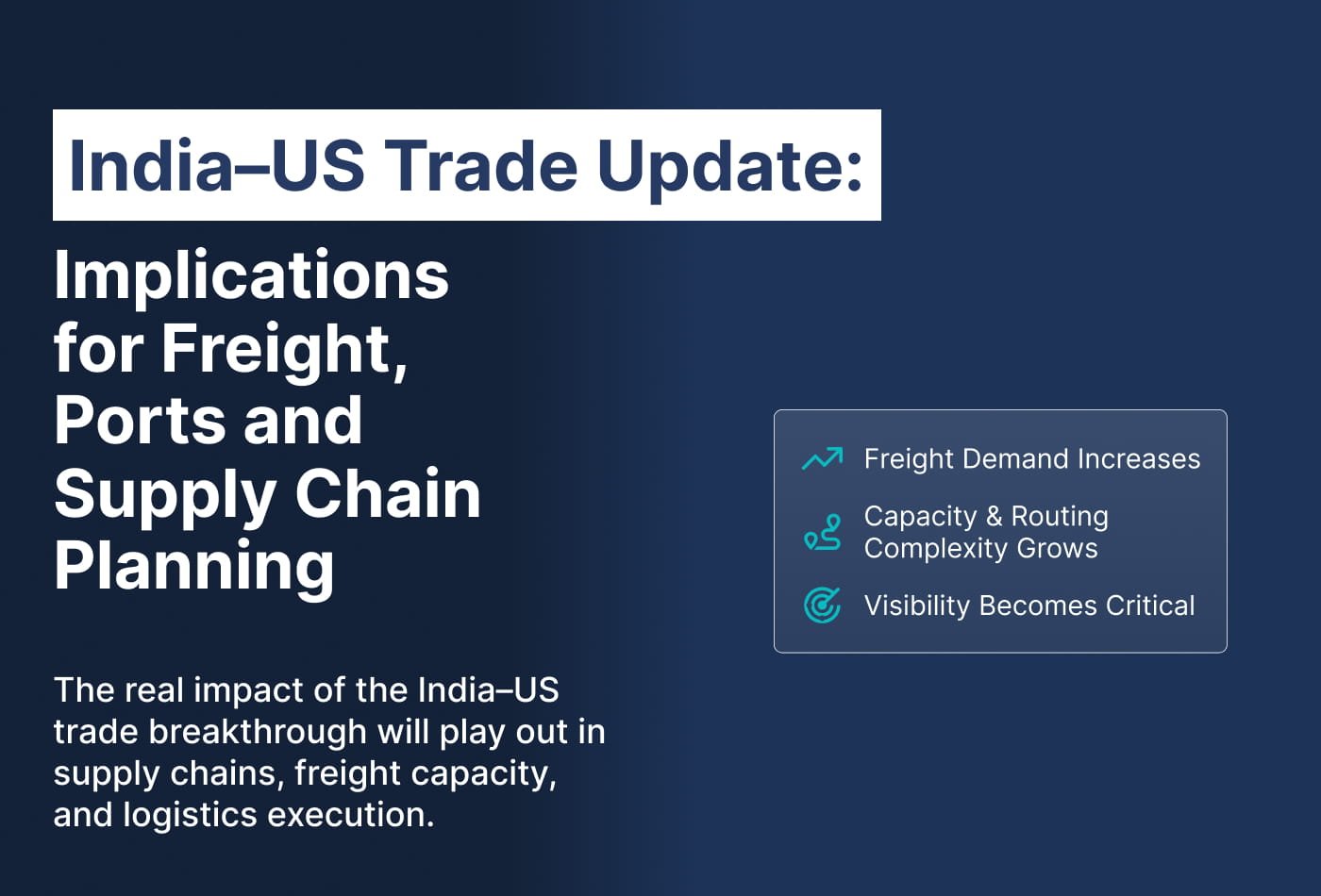
The recent India–US trade breakthrough marks a turning point in bilateral commerce, with implications that go far beyond tariffs and export volumes. For logistics leaders, exporters, and global supply chain planners, the real story lies in how trade flows, freight routes, and supply chain strategies are expected to transform.
As companies prepare for renewed market access, reduced policy uncertainty, and deeper economic cooperation, logistics readiness will determine who benefits most from this new trade momentum.
The Strategic Shift: From Policy Headlines to Physical Trade Flows
While trade agreements often dominate policy discussions, their true impact is visible in shipping lanes, warehouse demand, port congestion, and multimodal infrastructure.
With the India–US trade relationship moving towards a more stable framework, companies are likely to:
- Expand sourcing from India
- Diversify supply chains away from China-centric models
- Increase cross-border manufacturing and contract production
- Strengthen near-shoring and friend-shoring strategies
This creates direct ripple effects across ocean freight, air cargo, customs processes, and digital trade platforms.
Expected Changes in India–US Freight Routes
1. Increased Ocean Freight Volumes on Key Trade Lanes
India–US trade primarily moves via ocean freight through major ports such as:
- Nhava Sheva (JNPT)
- Mundra
- Chennai
- Visakhapatnam
With improved trade certainty, exporters in textiles, engineering goods, chemicals, and consumer products are expected to scale shipments. This could result in:
- Higher container throughput
- New direct services and liner capacity expansions
- Better freight rate stability over the medium term
2. Air Cargo Demand for High-Value Goods
For sectors like electronics, pharmaceuticals, and specialty manufacturing, faster market access could boost air freight demand for time-sensitive shipments.
Key trends may include:
- Growth in cross-border e-commerce shipments
- Increased pharma exports requiring cold chain logistics
- Demand for integrated express logistics solutions
Supply Chain Realignments: Why India Matters More
Strategy Accelerates
Global buyers are actively diversifying sourcing. The India–US trade breakthrough strengthens India’s role as a reliable alternative manufacturing hub.
This will drive:
- Contract manufacturing in India
- Expansion of global supplier networks
- Increased FDI in industrial corridors and export zones
US Buyers Seeking Supply Chain Resilience
US companies are increasingly prioritizing:
- Supply chain transparency
- Political stability
- ESG-compliant sourcing
India’s strengthened trade ties with the US improve confidence in long-term supplier relationships.
What This Means for Logistics & Freight Planning
1. Capacity Planning Becomes Critical
Exporters and logistics providers must anticipate:
- Higher container demand
- Peak-season congestion
- Carrier capacity constraints
Early freight booking, digital visibility tools, and dynamic routing will become essential.
2. Demand for Real-Time Shipment Visibility
As trade volumes increase, stakeholders will demand end-to-end shipment tracking, milestone visibility, and predictive ETA analytics.
Digital platforms like FreightMango PULSE can help businesses:
- Track ocean and air shipments in real time
- Monitor carrier performance
- Identify delays and reroute proactively
3. Multimodal Logistics Will Gain Importance
India’s logistics ecosystem is evolving with:
- Dedicated freight corridors
- Inland container depots (ICDs)
- Rail-linked ports and industrial parks
Exporters targeting the US will increasingly adopt rail + road + ocean multimodal solutions to optimize cost and transit time.
Cost Implications: Freight Rates & Trade Finance
Freight Rate Volatility
Trade optimism often leads to short-term demand spikes, which can push freight rates upward. However, medium-term capacity investments by carriers may stabilize costs.
Trade Finance & Working Capital
Higher export volumes will increase reliance on:
- Letters of credit
- Export factoring
- Supply chain finance platforms
Logistics intelligence platforms can help exporters optimize cash cycles by improving shipment predictability.
Compliance, Documentation & Digital Trade
As India–US trade deepens, compliance requirements may evolve. Exporters must prepare for:
- Enhanced customs documentation
- Product traceability requirements
- ESG and sustainability reporting
Digital freight platforms can automate documentation workflows and reduce compliance friction.
How FreightMango Helps Businesses Navigate the India–US Trade Shift
As global trade dynamics evolve, logistics intelligence and digital freight orchestration become key competitive advantages.
FreightMango empowers exporters and logistics leaders with:
- End-to-end freight booking across ocean and air
- Real-time shipment tracking and milestone alerts
- Carrier benchmarking and freight analytics
- Digital documentation and trade visibility tools
- Predictive logistics insights for better planning
With India–US trade volumes expected to rise, digital-first logistics will be the differentiator between reactive and resilient supply chains.
What Businesses Should Do Now
For Exporters
- Map US-focused product portfolios
- Secure long-term carrier partnerships
- Invest in supply chain visibility tools
For Logistics Providers
- Expand US trade lane capacity
- Offer integrated multimodal services
- Strengthen digital freight platforms
For Manufacturers
- Build US-compliant supplier ecosystems
- Improve ESG and traceability frameworks
- Align production planning with trade demand forecasts
Conclusion: Trade Breakthrough Meets Logistics Reality
The India–US trade breakthrough is not just a policy milestone—it is a logistics inflection point. Companies that invest in digital freight intelligence, predictive supply chain planning, and multimodal connectivity will be best positioned to capitalize on the next phase of global trade growth.
As India strengthens its position in global supply chains, platforms like FreightMango will play a critical role in enabling seamless, transparent, and efficient cross-border trade.
Share Your Thoughts
Post


 Continue with Google



 Get instant quote
and compare offers in real time
Get instant quote
and compare offers in real time