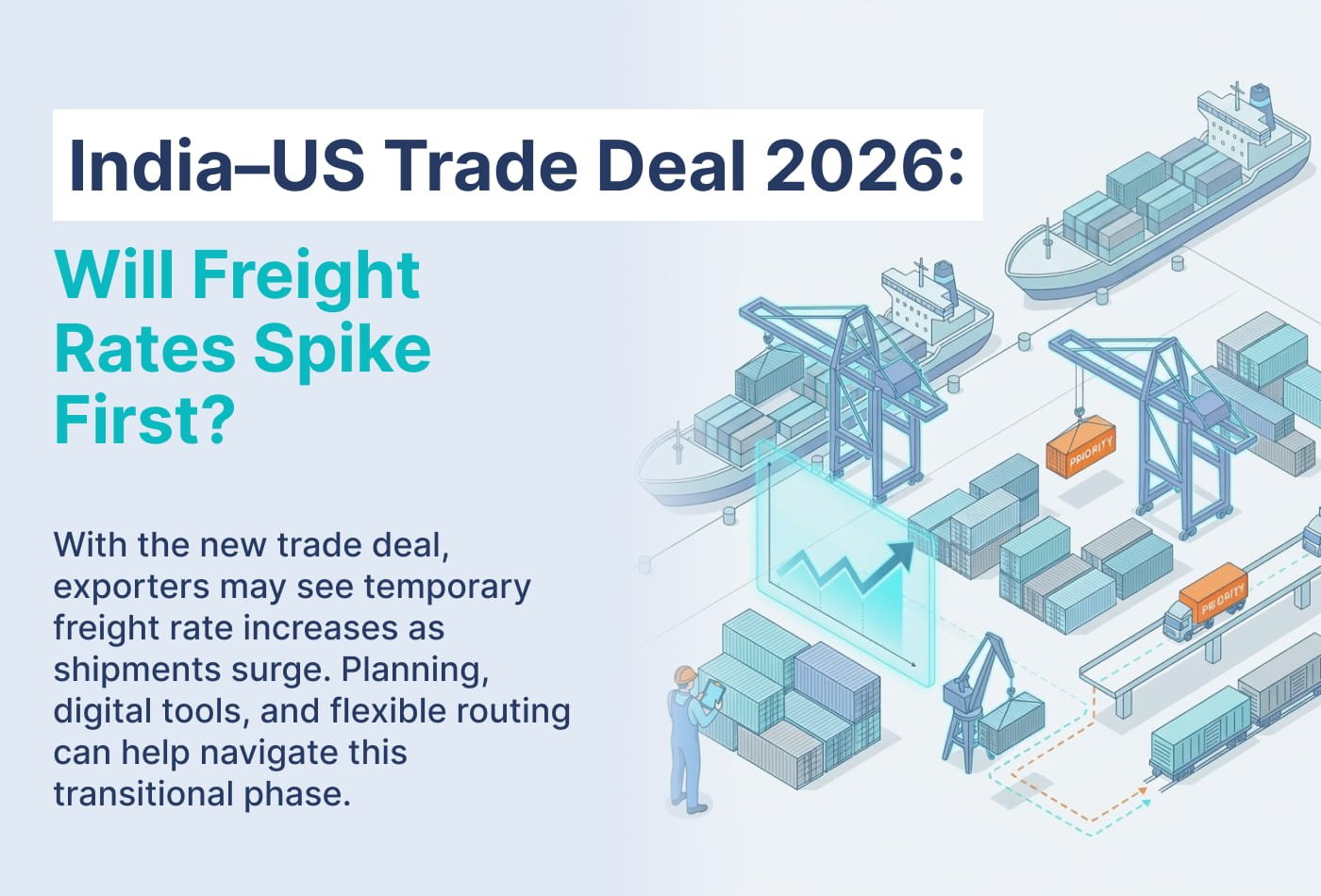
The landmark India–US trade agreement announced in early 2026 — which includes reducing reciprocal tariffs to 18 % from prior elevated levels — has injected optimism into bilateral commerce.
Yet, the freight market’s behavior is frequently decoupled from trade policy headlines. Before any long-term rate corrections, exporters could see freight rates rise in the short term before stabilizing or falling.
This blog explores why freight rates might first climb, what factors influence these dynamics, and how exporters can prepare.
1. Market Sentiment and Forward Booking
Immediately following trade deal announcements, market sentiment plays a key role:
- Freight forwarders and carriers anticipate higher demand, especially on Indian routes to the U.S.
- Spot bookings often surge as shippers try to lock in capacity in advance.
According to the latest logistics reports, capacity from the Indian subcontinent to North America currently outstrips demand, but expectations of rising volumes could change this rapidly.
As demand signals strengthen, carriers may adjust prices upward to manage capacity.
2. Demand–Capacity Rebalancing
The freight market responds to the balance between demand and vessel capacity:
- If demand increases quickly after tariff effects materialize, carriers may limit blank sailings, tighten space, or revise peak surcharges — all of which can drive higher freight rates.
- Conversely, if demand growth is gradual, rate rises may be muted.
Reports show that on some India–U.S. routes rates are currently lower, but may increase if demand accelerates.
3. Carrier Strategy and Routing
Carrier capacity decisions — such as routing through the Red Sea/Suez versus alternative paths — affect freight pricing:
- Routes through the Red Sea provide faster transit but can be impacted by regional volatility.
- Slower or longer routings ease congestion but reduce effective capacity.
Carriers may add forecast premiums if they see a potential volume surge, even before demand fully materializes — contributing to short-term rate increases.
4. Tariff Implementation Lag
Even though the trade deal has been announced and tariff cuts are expected to take effect, there is often a time lag between policy announcement and implementation.
During this lag:
- Buyers may accelerate orders
- Exporters may rush shipments to avoid transitional bottlenecks
- Carriers may anticipate shipping spikes
This mismatch in timing can temporarily tighten space and lift rates.
5. External Market Forces
Freight rates don’t move solely due to bilateral trade:
Global demand patterns (e.g., Europe, East Asia)
Fuel prices
Red Sea or Panama Canal disruptions
Overall capacity across the global network
All interact with India–U.S. trade flows. For instance, prior tariff shocks contributed to freight rate volatility and weaker rate levels in India-U.S. lanes.
6. Why Rates May Fall Eventually
Over the medium term — once the tariff framework settles, forecasts normalize, and carriers deploy additional capacity — freight rates could soften due to:
- Increased vessel allocations
- More competitive capacity offerings
- Reduced premium on space
- Improved operational predictability
Volumes may grow more predictably, smoothing rate volatility.
7. What Exporters Should Do
To navigate this phase:
Monitor freight futures and spot rate indicators
Plan shipments ahead of peak expected surges
Use digital freight platforms for rate transparency
Negotiate longer-range contracts where possible
Diversify routing and carriers to manage cost risk
Digital tools help businesses anticipate pricing changes and avoid margin dilution.
Conclusion
Yes, it’s very plausible that freight rates will rise before they fall following implementation of the India–US trade deal — driven by short-term demand spikes, carrier capacity adjustments, and market psychology.
However, over the medium to long term, increased trade volumes and stabilized policy effects should contribute to more predictable and potentially lower freight pricing.
Exporters who understand and plan for this transitional phase will be in the strongest position to protect margins and operational timelines.
Share Your Thoughts
Post


 Continue with Google



 Get instant quote
and compare offers in real time
Get instant quote
and compare offers in real time