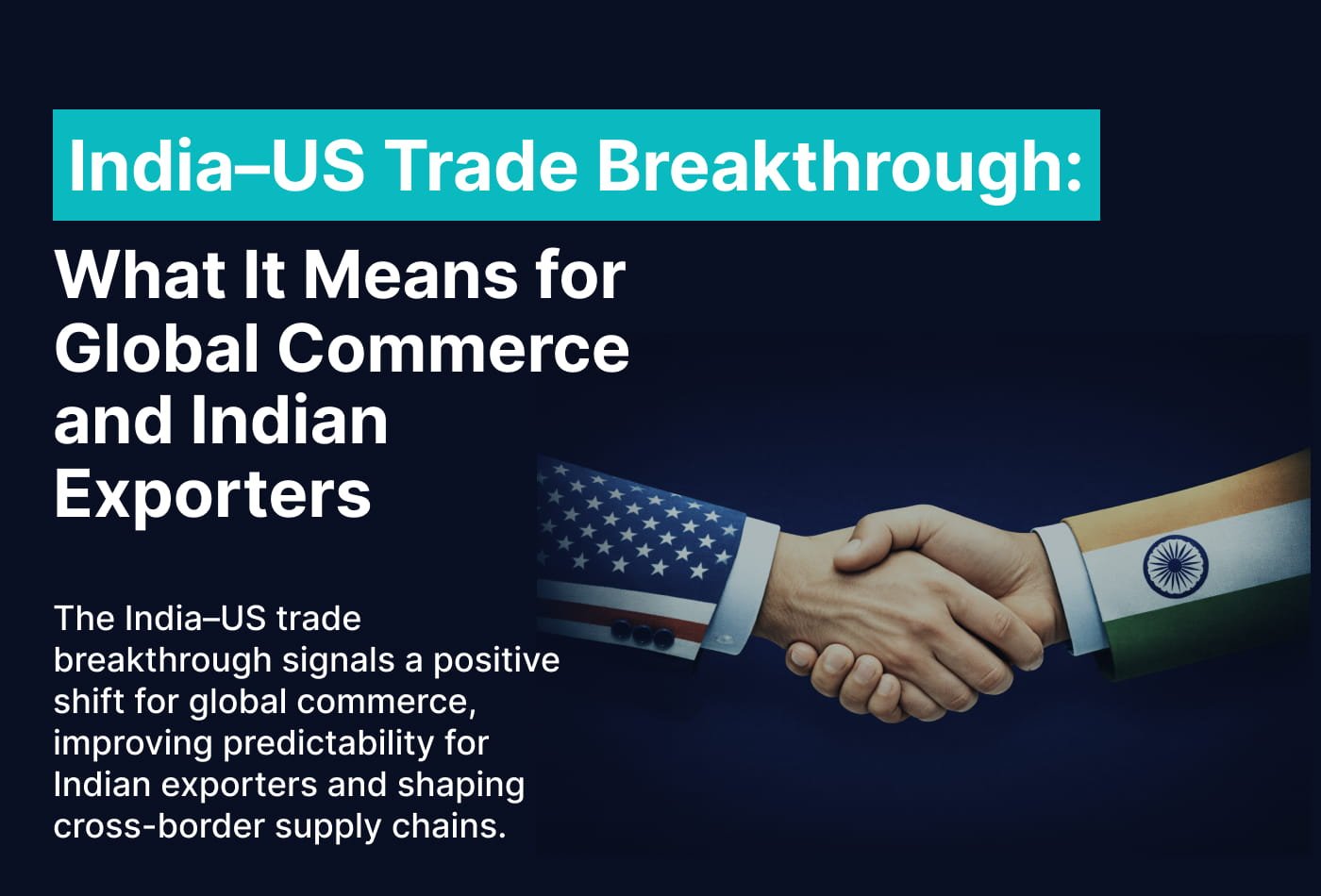
In early February 2026, after nearly a year of intense negotiations, India and the United States announced a significant trade breakthrough that resets one of the world’s most important commercial partnerships. The deal, publicly flagged by both Indian and U.S. leadership, centres on tariff realignment and promises to reshape trade flows between the two nations.
Tariff Reduction: From Trade Tensions to Competitive Access
One of the most talked-about components of the agreement is a major reduction in U.S. tariffs on Indian exports. According to official announcements:
- The effective U.S. tariff on Indian goods has been cut to approximately 18%, down from around 50% in late 2025.
- The earlier punitive tariffs were imposed after Washington raised concerns about India’s energy sourcing decisions, particularly its purchases of discounted Russian crude. The removal of these penalties is part of the broader trade understanding.
This dramatic reset — from punitive levels to 18% — is widely expected to restore much-needed competitiveness to Indian exporters across sectors like textiles, footwear, gems & jewellery, engineering goods and more.
Indicative Sector-Level Tariff Shifts
While the announced India–US trade understanding refers to an average effective U.S. tariff of around ~18% on Indian exports, early reporting and industry commentary indicate that several high-volume export sectors are expected to benefit from this rationalisation.
Rather than sharp, product-specific cuts, the current understanding points towards a broad alignment of duties across key categories, easing the impact of earlier elevated or punitive tariff levels.
Sectors likely to see positive impact include:
Textiles and Apparel
Labour-intensive segments such as apparel and made-ups, which were earlier subject to relatively higher effective duties, are expected to regain price competitiveness as tariffs converge closer to the ~18% level.
Home Textiles
Products like bed linen, towels and soft furnishings — core Indian export strengths — are expected to benefit from a more predictable and moderate tariff environment.
Gems and Jewellery
Select jewellery exports are likely to see improved margin stability as duties normalise under the revised framework.
Engineering Goods
Industrial and engineering exports, including fabricated metal products and components, stand to gain from reduced cost pressures and improved access to the U.S. market.
Leather and Footwear
Export-oriented leather goods and footwear manufacturers, which are sensitive to duty fluctuations, are expected to benefit from the tariff reset.
At this stage, publicly available sources confirm the overall tariff reduction to ~18%, while detailed HS-code-wise schedules and implementation mechanics are expected to be released subsequently by authorities.
Why the Tariff Drop Matters
For India’s export-oriented industries, the tariff shift is more than a headline number:
- Exporters regain price competitiveness against Asian peers like Vietnam and Bangladesh, whose tariffs generally hover around similar levels.
- Labour-intensive sectors hit hardest by previous duties — including apparel, home decor and leather goods — are expected to see renewed demand from U.S. buyers.
- The move sends a clarity signal to global supply chain managers eyeing India as an alternative to traditional manufacturing hubs. An 18% tariff aligns India with many competitive emerging markets rather than isolating it behind punitive barriers.
Finance Minister Nirmala Sitharaman described the development as a positive signal for Indian exports, suggesting that reduced duties will help markets and exporters “pick up now.”
Beyond Tariffs: Strategic Dimensions
The deal isn’t just about tariff rates — it also carries broader strategic implications:
- Energy and trade cooperation are part of the discussions, with U.S. officials highlighting shifts in India’s energy import patterns as linked to tariff relief.
- India has reportedly agreed to lower certain trade barriers and tariffs on U.S. goods, which could eventually include sectors like industrial goods and agricultural produce — though details are still being finalized.
- The understanding sets a foundation for deeper dialogue on manufacturing linkages, technology exchange and investment flows.
This comprehensive reset has been described by commentators as a strategic pivot in India’s trade relations — one that could open doors for more balanced and sustained engagement with Western markets.
What It Means for Freight and Trade Logistics
For freight and logistics companies, this breakthrough may lead to:
- Increased cargo volumes as exporters regain confidence in U.S. demand.
- Shift in trade lanes, with traditional markets like the EU and Middle East complemented by renewed flows to North America.
- Opportunities in multi-modal logistics, as cargo movement patterns evolve with tariff-driven demand.
- Renewed interest in freight optimisation services, trade financing and export support.
Given FreightMango’s footprint in supporting exporters and importers, this development could fuel increased demand for logistics visibility, customs compliance solutions and efficient cross-border freight management.
The Timing: When Did This Happen?
The tariff reduction and related trade agreement were announced in late January — early February 2026, with public statements from the Indian government and U.S. administration coming out around February 2–4, 2026.
At this stage, full legally binding texts are expected to be published later in 2026, as negotiating teams complete the detailed framework and implementation schedules.
Summary
The India–US trade breakthrough marks an important reset in bilateral trade, with the reduction of effective U.S. tariffs to around ~18% expected to improve export competitiveness across multiple Indian sectors. While detailed product-level schedules are still awaited, the broader direction points towards renewed momentum in U.S.-bound trade flows and evolving supply chain strategies.
As exporters prepare to capitalize on this shift, execution on the ground becomes just as critical as policy intent. From selecting the right trade lanes and managing documentation to ensuring visibility across ocean and air shipments, logistics readiness will play a defining role in how effectively businesses convert tariff relief into real trade gains.
FreightMango supports exporters and importers at every stage of this journey — with integrated freight booking, real-time shipment visibility, customs-aligned processes and digital tools designed to simplify cross-border trade. As India–US trade dynamics evolve, having a connected logistics partner can help businesses move faster, smarter and with greater confidence.
Share Your Thoughts
Post


 Continue with Google



 Get instant quote
and compare offers in real time
Get instant quote
and compare offers in real time