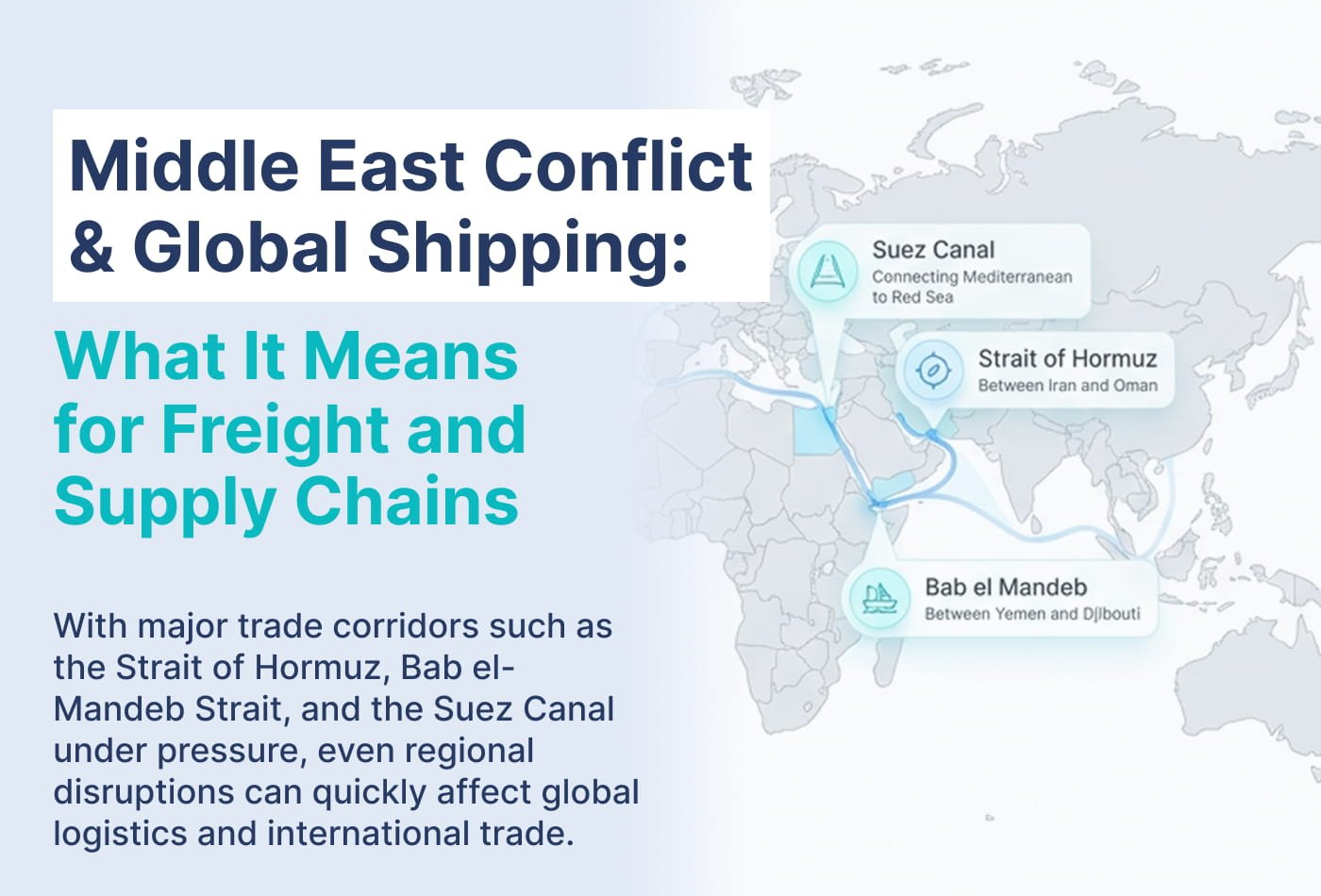
The Middle East has once again become a focal point of global supply chain disruption. Escalating geopolitical tensions across the region — including military actions involving Iran and growing instability around key maritime corridors — are already reshaping freight routes, insurance costs, and logistics planning worldwide.
For businesses moving cargo across Asia, Europe, Africa, and the Middle East, the implications are significant. Critical shipping chokepoints are under pressure, carriers are rerouting vessels, and freight rates are showing renewed volatility.
Here’s a closer look at how the current situation is affecting global logistics and what shippers should expect in the coming months.
Why the Middle East Matters to Global Shipping
The Middle East sits at the center of several of the world’s most important maritime trade corridors. These routes connect Asian manufacturing hubs with European and American markets and also serve as key channels for global energy exports.
Some of the most critical chokepoints include:
- Strait of Hormuz
- Bab el-Mandeb Strait
- Red Sea and Suez Canal route
Disruptions in any of these corridors can quickly ripple across global supply chains.
For example, the Suez Canal route alone handles roughly 15–30% of global maritime trade, making it one of the busiest shipping corridors in the world. Any disruption in the region can quickly impact freight markets across continents.
Escalating Tensions and Immediate Shipping Disruptions
Recent military activity and security concerns in the region have triggered widespread caution among shipping companies, insurers, and global traders.
Reports indicate that commercial shipping traffic through the Strait of Hormuz has dropped sharply as vessels wait offshore while carriers reassess security risks. Several shipping lines have slowed operations, delayed sailings, or temporarily paused bookings to certain Gulf ports.
This passage normally handles around 20% of global oil shipments, making it one of the most strategically important waterways in the world.
As a result:
- Some vessels are delaying entry into Gulf waters
- Tankers and container ships are waiting offshore
- Shipping lines are reassessing sailing schedules
- Maritime insurers are reviewing war-risk coverage
Insurance providers have also tightened war-risk coverage for parts of the Gulf, significantly increasing the operational risk and cost for vessels operating in the region.
Freight Rates and Insurance Costs Are Rising
Uncertainty in the region is already affecting freight pricing across several trade lanes.
Shipping rates on certain Middle East routes have risen sharply as carriers factor in additional risk and operational complexity. Exporters across Asia have reported sudden cost increases linked to war-risk surcharges and insurance premiums.
Carriers have begun introducing additional charges such as:
- War-risk surcharges
- Emergency operational fees
- Security-related insurance premiums
In some cases, exporters have reported container freight costs from India to Gulf destinations increasing dramatically as available vessel capacity tightens.
These additional costs are likely to cascade through supply chains, eventually affecting product prices and global trade flows.
Containers Are Being Diverted to Alternative Ports
As security risks increase in parts of the Gulf region, some shipping lines are adjusting port rotations and diverting cargo to alternative hubs.
Containers originally destined for Gulf ports are increasingly being discharged at regional transshipment ports such as:
- Sohar (Oman)
- Salalah (Oman)
- Khorfakkan (UAE)
- Colombo (Sri Lanka)
- Mundra (India)
Cargo owners may be required to arrange onward transportation from these ports or rebook shipments, adding an additional layer of operational complexity for importers and exporters.
Route Diversions Are Increasing Transit Times
To avoid high-risk maritime zones, shipping lines are also evaluating longer alternative routes.
During previous disruptions in the region, many vessels avoided the Red Sea corridor and sailed around the Cape of Good Hope, a much longer route connecting Asia and Europe.
Such diversions can add 10–20 days to transit times, depending on the trade lane.
Longer routes create several operational challenges:
- Higher fuel consumption
- Reduced vessel capacity availability
- Longer delivery timelines
- Congestion at alternative ports
These factors can tighten container availability globally and contribute to volatility in freight rates.
Ripple Effects Beyond Ocean Freight
The impact of the conflict extends beyond container shipping.
Supply chains linked to energy, agriculture, and manufacturing are also experiencing disruption due to the region’s importance in global commodity trade.
For instance:
- Fertilizer exports from the Middle East are facing logistical challenges
- Energy market volatility is increasing bunker fuel costs
- Industries dependent on Middle East raw materials are facing potential supply risks
Because global supply chains are deeply interconnected, disruptions in the region can affect industries ranging from pharmaceuticals and electronics to industrial manufacturing.
Impact on Indian Exporters and Importers
For Indian businesses, the situation is particularly important.
Trade routes connecting India to Europe, North Africa, and the Mediterranean rely heavily on the Suez Canal and Red Sea corridor. Disruptions along these routes can lead to:
- Higher freight rates
- Shipment delays
- Increased insurance costs
- Reduced vessel frequency
Some exporters have also reported shipments being delayed or rerouted due to operational uncertainty in the Gulf region.
To help manage the situation, Indian authorities have introduced temporary operational relaxations allowing export cargo returning from disrupted Middle East routes to be handled more efficiently at Indian ports.
Industries such as textiles, chemicals, engineering goods, and agriculture could experience higher logistics costs if disruptions persist.
Operational Challenges for Freight Forwarders
Freight forwarders and logistics providers are currently navigating a rapidly changing environment.
Carriers are adjusting sailing schedules, revising port rotations, and issuing frequent operational advisories as the situation evolves.
This means logistics teams must now manage:
- Booking uncertainties
- Changing vessel schedules
- Cargo diversions
- Rapid freight rate fluctuations
As a result, real-time visibility and flexible shipping planning have become critical for businesses managing international trade.
What Businesses Should Expect Next
While the situation remains fluid, logistics experts expect several trends to continue in the near term:
1. Continued rate volatility
Freight prices may fluctuate depending on security conditions and vessel availability.
2. Operational rerouting
Carriers may increasingly avoid high-risk zones, leading to longer transit times.
3. Higher insurance premiums
War-risk coverage costs are likely to remain elevated.
4. Supply chain planning adjustments
Businesses may need to build additional buffers into shipping schedules and inventory planning.
Navigating Uncertainty in Global Logistics
Geopolitical risks are becoming an increasingly important factor in supply chain planning. The current Middle East tensions highlight how quickly developments in one region can reshape global freight markets.
For logistics teams, the focus now is on maintaining visibility, flexibility, and contingency planning as the situation evolves.
Monitoring trade route disruptions, freight rate changes, and carrier advisories will be critical for businesses navigating global logistics in the months ahead.
Share Your Thoughts
Post


 Continue with Google



 Get instant quote
and compare offers in real time
Get instant quote
and compare offers in real time