For decades, global trade has largely depended on predictable, port-to-port ocean shipping. Cargo moved through established sea routes, with well-defined transit times and minimal need for intervention.
But recent disruptions across key regions have exposed a critical limitation in this model.
When ocean routes become uncertain — not closed, but unpredictable — supply chains need alternatives that can adapt in real time.This is where land-bridge logistics is making a strong comeback.
Across the Middle East and other strategic regions, companies are increasingly shifting cargo through multi-modal routes that combine sea and land transport. What was once considered a niche alternative is now becoming a practical and scalable solution.
What Is Land-Bridge Logistics?
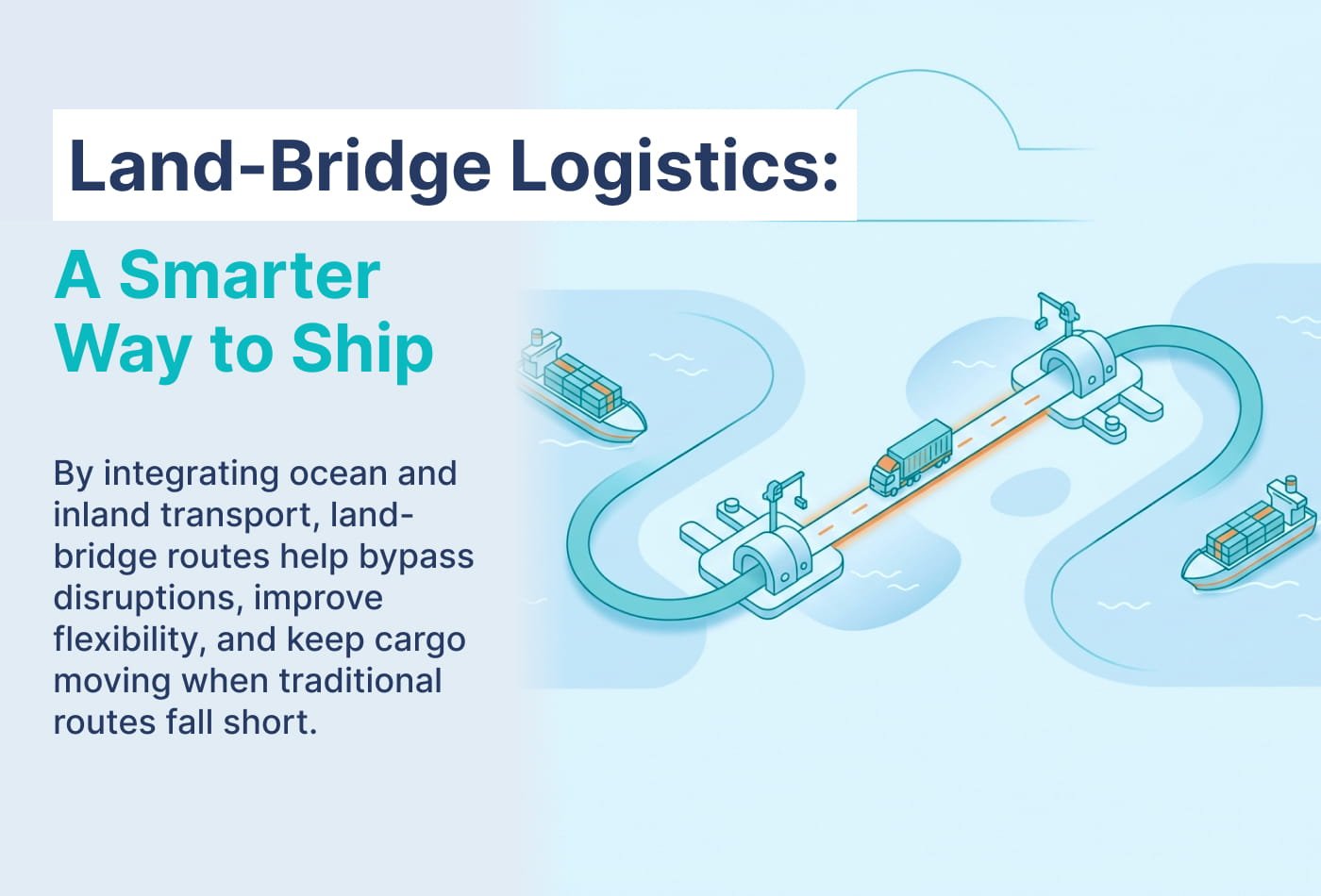
Land-bridge logistics refers to the movement of cargo between two seaports using inland transportation — typically road or rail — instead of relying entirely on ocean routes.
For example:
- Cargo arriving at one port is transported via land corridors across a country or region
- It is then reloaded onto another vessel at a different port for onward shipping
This approach effectively bypasses high-risk or congested maritime routes, while maintaining overall cargo flow.
Why Land-Bridge Routes Are Gaining Momentum Again
1. Ocean Routes Are Active — But Less Predictable
Today’s disruptions are not always visible in the form of closures. Instead, they show up as:
- Sudden route diversions
- Port congestion in unexpected locations
- Changing carrier schedules
- Increased transit time variability
In such conditions, relying entirely on ocean freight creates exposure to delays and uncertainty. Land-bridge routes offer a way to regain control over parts of the journey.
2. Speed and Flexibility Are Becoming Priorities
In uncertain environments, the fastest route is not always the shortest.
By combining sea and land transport:
- Cargo can bypass longer maritime detours
- Transit times can be optimized based on current conditions
- Businesses can respond faster to disruptions
This flexibility is increasingly valuable for time-sensitive shipments.
3. Infrastructure Has Improved Significantly
Regions like the Middle East have invested heavily in:
- Road and rail connectivity
- Port infrastructure
- Cross-border logistics capabilities
This has made land-bridge routes more viable, efficient, and scalable than before. As a result, these routes are no longer just contingency options — they are becoming strategic alternatives.
4. Supply Chains Are Shifting Toward Multi-Modal Thinking
The traditional model of “book ocean freight and wait” is evolving.
Today, logistics teams are:
- Evaluating multiple routing combinations
- Integrating different modes of transport
- Adapting shipment plans dynamically
This marks a clear shift from single-mode execution → multi-modal strategy.
What This Means for Importers & Exporters
The rise of land-bridge logistics is not just an operational change — it has direct implications for how businesses plan and manage shipments.
1. Ocean-Only Planning Is No Longer Enough
Relying solely on port-to-port shipping limits flexibility.
Importers and exporters should start evaluating:
- Alternate entry and exit ports
- Inland transport options between regions
- Multi-leg shipment planning
Having these options ready can significantly reduce risk during disruptions.
2. Routing Decisions Need to Be More Dynamic
The “best route” is no longer fixed.
It can change based on:
- Current congestion levels
- Regional disruptions
- Carrier schedule adjustments
This means routing decisions should be revisited more frequently — not locked in weeks in advance.
3. Visibility Across Modes Becomes Critical
Managing a multi-modal shipment is more complex than tracking a single ocean leg.
Businesses need visibility across:
- Port operations
- Inland transport movement
- Transshipment points
Without this, delays in one leg can disrupt the entire shipment without early warning.
4. Cost vs Reliability Trade-offs Will Increase
Land-bridge routes may sometimes involve:
- Higher handling costs
- Additional coordination
- Multiple service providers
However, in many cases, they offer:
- Faster delivery
- Lower risk of major delays
- Better predictability
Businesses will need to balance cost against reliability more actively than before.
The Bigger Shift: From Fixed Routes to Adaptive Networks
What we are seeing is not just the return of land-bridge logistics — it is a broader transformation in how supply chains operate.
Earlier:
- Routes were fixed
- Modes were predefined
- Execution was linear
Now:
- Routes are flexible
- Modes are combined
- Execution is adaptive
Supply chains are evolving into dynamic networks, where cargo can move through multiple paths depending on real-time conditions.
How FreightMango Supports Multi-Modal Decision Making
As supply chains become more complex, decision-making becomes more critical.
FreightMango helps importers and exporters:
- Compare multiple routing options across ocean, air, and land
- Evaluate trade-offs between cost, transit time, and reliability
- Track shipments across different transport modes in one place
- Respond quickly to disruptions with better visibility
This enables businesses to move beyond static planning and make smarter, faster logistics decisions.
Conclusion
Land-bridge logistics is no longer just a backup plan. It is becoming an essential part of modern supply chain strategy. As global trade becomes more unpredictable, the ability to combine different transport modes and adapt routing decisions in real time will define success.
Because in today’s environment, the question is no longer:
“What is the standard route?”
It is:
“What is the most reliable way to move cargo right now?”
Share Your Thoughts
Post


 Continue with Google



 Get instant quote
and compare offers in real time
Get instant quote
and compare offers in real time